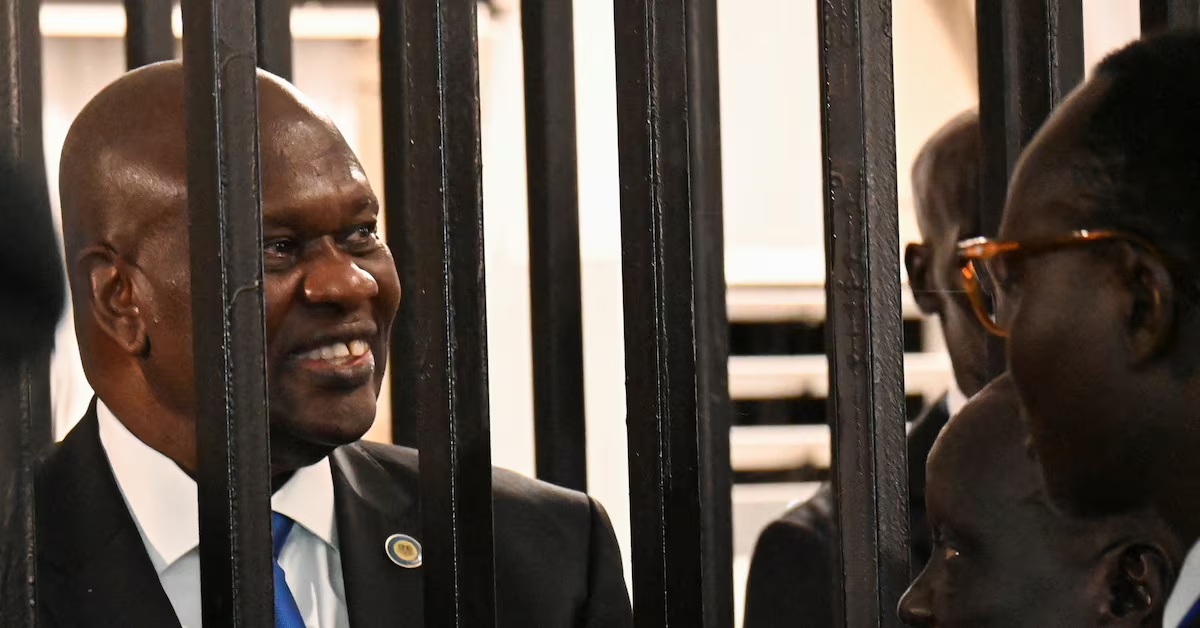
Dr. Machar Behind the Bar (Courtesy)
Abuja, Februray 19, 2026
By Savanna Radio News
Nigeria has publicly urged South Sudan to immediately and unconditionally release First Vice President Riek Machar, prompting a firm pushback from Juba and a defiant political response from the SPLM/A‑IO. At the recent African Union high‑level meetings in Addis Ababa, Nigeria declared renewed support for South Sudan’s faltering peace process and put Machar’s detention at the center of its proposals. Nigeria, speaking through Vice President Kashim Shettima on behalf of President Bola Tinubu, called on the government of South Sudan to “consider the immediate and unconditional release” of Machar and other detained opposition figures as a prerequisite for credible elections and an inclusive transition. Abuja framed Machar’s release as essential to restoring trust in the revitalized peace agreement and creating conditions for the planned December 2026 polls to proceed without further delay.
Nigeria’s position aligns with a broader chorus of African leaders in the AU’s C5 mechanism and other regional forums who argue that keeping key opposition leaders behind bars while preparing for elections undermines both the peace deal and the legitimacy of any future vote. At the AU summit, South African President Cyril Ramaphosa, chairing the C5, echoed the demand for the release of political detainees, explicitly naming Machar and warning Juba that the region would not accept further slippages in the electoral roadmap.
South Sudan government’s response
The government in Juba has so far rejected external appeals to free Machar, insisting his case is a matter for the courts, not political negotiation. Officials have repeatedly argued that Machar’s arrest followed violence in Nasir County in March 2025 and that he now faces serious charges, including murder, treason, and crimes against humanity, before a Special Court in Juba. Authorities say the proceedings are lawful and necessary, portraying his detention as a step to protect the state and the peace process from what they describe as destabilizing actions by armed opposition elements.
In public messaging, senior figures close to President Salva Kiir have framed calls from Nigeria, South Africa, and other African leaders as “undue interference” in South Sudan’s judiciary and internal affairs. They maintain that only the courts can decide Machar’s fate and that the executive cannot simply “release” a defendant once a trial has begun. The government previously rejected a similar appeal by the African Union Peace and Security Council for Machar’s immediate and unconditional release, signaling a consistent line against political concessions on the case.
SPLM/A‑IO’s reaction
Machar’s SPLM/A‑IO has condemned the government’s stance and strongly backed Nigeria’s call, arguing that his detention is politically motivated and aimed at excluding the main armed opposition from the transition. The movement under Machar’s leadership has already declared the Revitalised Agreement on the Resolution of the Conflict in South Sudan (R‑ARCSS) “defunct,” saying the arrest of the First Vice President and other senior leaders violates both the letter and spirit of the peace deal. SPLM/A‑IO figures insist that any credible peace process or national dialogue must begin with Machar’s release and full restoration of his political and constitutional roles.
SPLM/A‑IO officials and allied activists describe the Special Court proceedings as a “show trial,” highlighting due‑process concerns, restricted media access, and the court’s refusal to recognize Machar’s immunity as a sitting vice president or to defer grave crimes to the AU‑mandated hybrid court. They argue that Juba is using the judiciary to neutralize the opposition ahead of the 2026 elections and to rewrite the balance of power outside the framework of the peace agreement. In their view, Nigeria’s intervention is a welcome sign that regional patience with Kiir’s approach is running out, and they are urging Abuja and other AU members to maintain pressure, including by linking support for the electoral calendar to concrete steps on political detainees.
Implications for the peace process
Nigeria’s call has sharpened a growing regional debate over whether South Sudan’s leadership is still committed to the revitalized peace agreement or instead using legal and security tools to manage rivals while running down the clock to elections. While Juba insists that institutions must be allowed to function without interference, critics warn that keeping Machar under house arrest and his allies in detention risks triggering further SPLM/A‑IO fragmentation, renewed violence in flashpoint areas, and a deeper crisis of legitimacy around the 2026 polls.
For now, the standoff over Machar’s fate has become a litmus test of both South Sudan’s political will to implement the peace deal and the region’s readiness to enforce its own commitments. How Juba responds to the Nigerian and wider AU pressure in the coming months could determine whether the country moves toward a genuinely inclusive transition, or slides back into a familiar cycle of exclusion, contestation, and conflict.













Post comments (0)