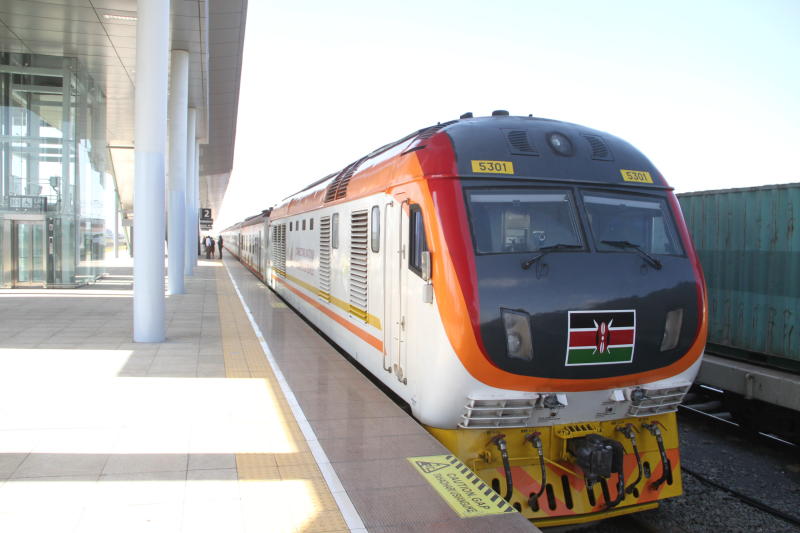
Standard Gauge Railway (SGR) from the Chinese operator (Courtesy)
Nairobi, March 21, 2026
Savanna Radio News Bulletin
Kenya has moved to unlock new growth across East Africa by resuming work on a major Standard Gauge Railway (SGR) extension that will finally link the Port of Mombasa to the border with Uganda. The project is expected to speed up cargo movement, cut transport costs, and position the country as the primary gateway for regional trade.
Construction has resumed on the long-delayed Naivasha–Kisumu–Malaba SGR section, a corridor that will extend the modern railway from its current inland terminus in Naivasha to the Kenya–Uganda border at Malaba. The new phase, covering several hundred kilometres, will complete a nearly 1,000‑kilometre continuous rail artery from Mombasa on the Indian Ocean to western Kenya.
President William Ruto presided over the groundbreaking in Suswa, Narok County, describing the project as a “game-changer” for Kenya’s Vision 2030 agenda and for the broader East African Community (EAC) economy. The government has framed the expansion as a strategic investment to revive a scheme that had stalled for almost six years due to funding and debt concerns.
Boost to trade and regional integration
By pushing the SGR to Malaba, Kenya aims to sharply reduce transit times and logistics costs for cargo headed to Uganda, Rwanda, South Sudan, the Democratic Republic of Congo and beyond. Freight trains on the existing SGR already move goods faster and more securely than road haulage, helping to decongest the port of Mombasa and easing pressure on the Northern Corridor highway.
The new line is designed to integrate seamlessly with Uganda’s own SGR plans toward Kampala, creating a continuous modern rail spine from the Indian Ocean deep into the Great Lakes region. Kenyan and Ugandan authorities have both described the corridor as a regional “artery” for key exports such as coffee and minerals, as well as for fuel and manufactured imports.
Infrastructure details and financing
The latest construction phase includes major civil works such as bridges, tunnels, culverts and new passenger and freight stations along the Naivasha–Kisumu–Malaba route. Officials say the railway will be capable of hauling up to 4,000 tonnes of cargo per train, significantly expanding capacity compared to existing services.
After earlier reliance on external loans, the government is now supplementing financing through a railway development levy charged on cargo, as part of efforts to keep the project moving while managing debt risks. Authorities argue that the medium‑ to long‑term gains in trade volumes, jobs and tax revenue will outweigh the upfront costs of construction.
Local impacts and growth corridors
Studies of Kenya’s existing SGR segments show the railway has already begun to reshape settlement patterns, land values and business activity along the Mombasa–Nairobi–Naivasha corridor. New trade hubs, logistics parks and real estate developments have emerged near stations, even as some roadside towns that depended on long‑distance trucking have struggled with declining traffic.
Officials say they plan to incorporate lessons from earlier phases to better manage land acquisition, community displacement and environmental concerns on the western extension. County leaders in western Kenya are also positioning their regions to tap into new investment in warehousing, agro‑processing, tourism and services once SGR services reach Kisumu and the Malaba border.
Kenya’s bid to anchor East African logistics
For Kenya, the full Mombasa–Malaba SGR is key to reinforcing its role as the main transport and logistics hub for the EAC in the face of growing competition from alternative routes in Tanzania and elsewhere. A more efficient rail link is expected to make the Northern Corridor more attractive to shippers, deepen regional integration and support continental trade ambitions under the African Continental Free Trade Area (AfCFTA).
With construction now back on track, Nairobi and Kampala will face close scrutiny over how quickly they can deliver the remaining segments and how widely the benefits of this multi‑billion‑shilling investment are shared among communities along the line.























Post comments (0)