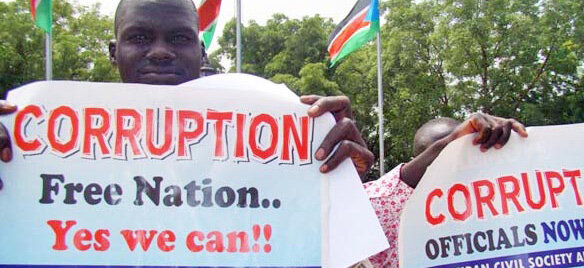
Corruption Rally (Courtesy)
Juba, February 27, 2026
By Savanna Radio Auditors
A deepening wave of political and institutional shock is gripping South Sudan as reports of a broad purge of public officials intersect with the recent high‑profile arrest of the former Minister of Finance and the Governor of the Central Bank, fuelling public anger and sharp debate over corruption, power struggles, and the rule of law. Unverified sources indicate that a Government High‑Level Committee is driving an aggressive process of dismissals, arrests, investigations, and court proceedings targeting more than 70 public servants across ministries, financial institutions, security organs, and state administrations, with the finance and monetary leadership crisis seen as the most visible tip of a much larger iceberg.
The dramatic detention of the former Minister of Finance and the Central Bank Governor has been officially framed as part of a renewed drive against economic mismanagement and alleged financial wrongdoing, but many citizens and analysts view it through a dual lens: on one hand, as long‑overdue action in a country where systemic corruption, illicit enrichment, and diversion of public funds have crippled services and deepened poverty; on the other, as a politically selective and opaque process that may shield powerful networks while sacrificing a few high‑profile figures. The timing of their arrest, combined with reports of a confidential list of dozens of other targeted officials, has prompted speculation that anti‑corruption rhetoric is being mixed with internal power consolidation and factional score‑settling within the ruling elite.
On the streets of Juba and other major towns, public reaction is a complex blend of anger, cautious hope, and deep mistrust. Many ordinary South Sudanese, exhausted by years of economic hardship and unpaid salaries, initially welcomed the sight of senior financial officials facing accountability, expressing hope that “for once, the big fish are being touched.” At the same time, there is widespread scepticism that justice will go beyond a few scapegoats: people question why only certain individuals are arrested while others long accused of corruption remain in office, and why the processes are shrouded in secrecy, with limited information on charges, evidence, or court timelines. Taxi drivers, market traders, and civil servants interviewed informally speak of fear permeating government offices, rumours of “lists” circulating in WhatsApp groups, and worries that some arrests may be driven more by political loyalty tests than by transparent investigations.
Editor’s Analysis:
The convergence of the alleged civil service purge with the arrest of the former Finance Minister and Central Bank Governor marks a critical inflection point for South Sudan’s governance trajectory. If handled with transparency, due process, and equal application of the law, this moment could lay the groundwork for a genuine anti‑corruption campaign that begins to rebuild public trust in state institutions. However, the current opacity surrounding the High‑Level Committee, the absence of clear legal procedures, and the perception of selective targeting risk turning this episode into yet another chapter of politically managed justice, where corruption is punished not as a systemic crime but as a weapon in internal power struggles. For a country still in fragile transition, the key test will be whether the state opens these cases to public scrutiny, allows independent oversight, and widens accountability to include all implicated actors, regardless of rank or faction or whether the purge will instead deepen fear, entrench impunity, and further erode confidence in the promise of a more accountable and democratic South Sudan.














Post comments (0)