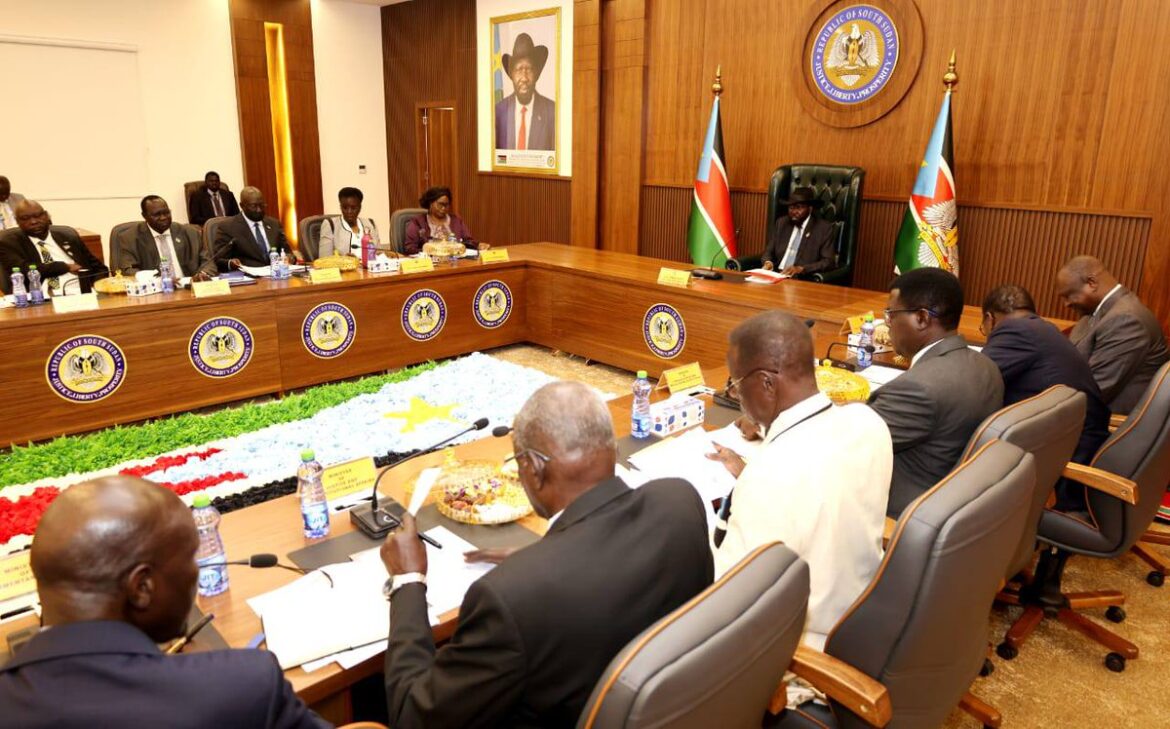
President Kiir Presiding over Council of Ministers (File:Courtesy)
Juba, February 20, 2026
By Savanna Radio News Desk
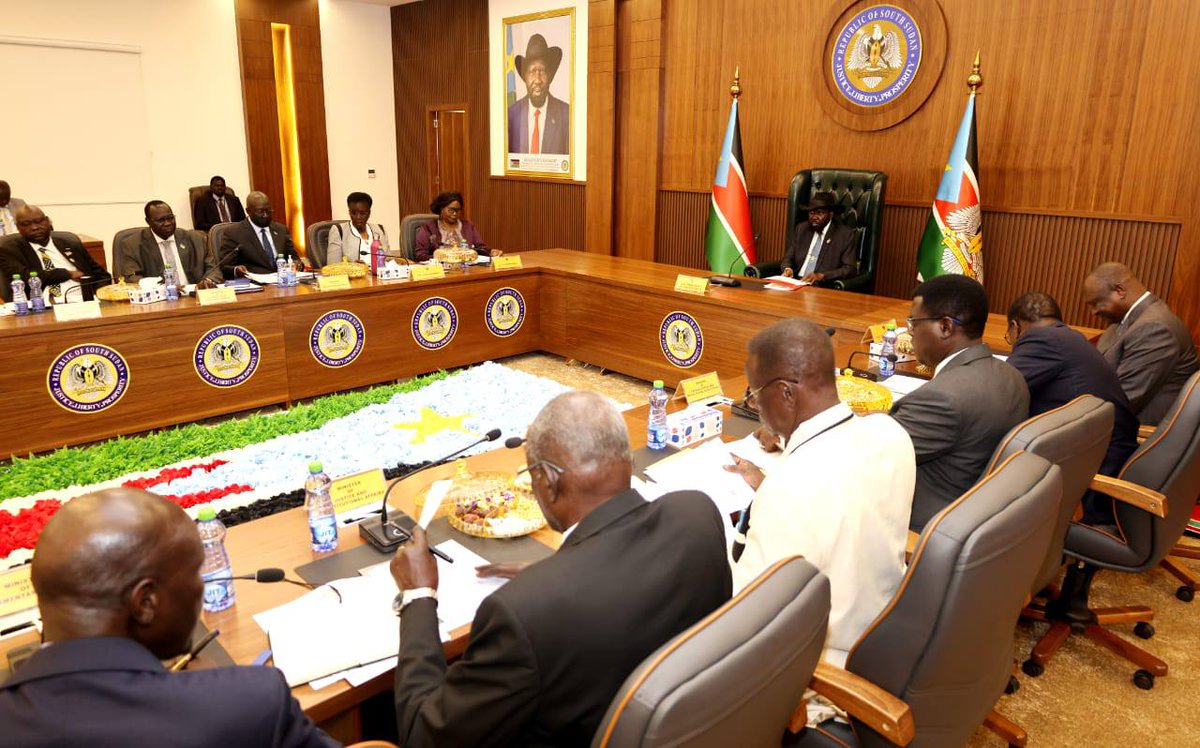
South Sudan’s cabinet has approved a new 2 billion US dollar roads deal backed by the country’s gold reserves, reviving sharp questions about how previous “oil for road” projects were handled and what this means for the public interest. The Council of Ministers, chaired by President Salva Kiir, endorsed a proposal to give a sovereign guarantee to Shamrock Global Group to construct and upgrade more than 1,000 km of “strategic” roads, including the Juba–Yei–Kaya, Yei–Faraksika–Maridi, Juba–Lobonok–Moli Junction, and Wau–Raja–Boro Medina corridors. The deal, valued at about 2 billion US dollars, is to be collateralized with South Sudan’s gold, with officials describing it as a “historic” step for infrastructure but providing no details on interest rates, repayment schedules, or how the gold will be valued and protected. According to the information minister, each kilometre under the project is projected to cost roughly 2.3 million US dollars, but there is no clarity yet on whether the contract went through open competitive bidding, independent technical due diligence, or parliamentary scrutiny.
What happened to the “oil for road” programme?
The gold‑for‑roads plan comes only a few years after the government launched the “oil for roads” initiative, in which future crude oil shipments were effectively pre‑sold to finance major road construction. Investigations by media outlets and rights groups found that the oil‑backed programme was marked by secrecy, lack of competitive tendering, and heavy reliance on politically connected companies, especially firms linked to businessman and former vice president Bol Mel. A 2025 report by the UN Commission on Human Rights in South Sudan concluded that systemic corruption had diverted billions in oil and non‑oil revenues and described corruption as an “engine” of the country’s decline. The same report said that over 90 percent of planned road works under oil‑for‑roads were never completed, while about 1.7 billion US dollars in contracts went to companies tied to Bol Mel. In practice, this meant the public lost both the oil and the promised roads: future barrels of crude were committed, but most of the roads were not delivered, and there was no full public accounting of where the money went.
Why the new deal raises public concern
Civil society actors warn that the new gold‑backed scheme risks repeating the same mistakes this time with the country’s gold instead of oil. Edmund Yakani of CEPO said the agreement “repeats the mistakes of the previous oil‑for‑roads scheme and could burden future generations,” arguing that leaders are mortgaging future resources for today’s opaque deals. He called the decision “suicidal” for future generations and urged parliament and civil society to intervene unless strict safeguards are put in place.
The main red flags for the public include:
-
Using a strategic, finite resource (gold) as collateral without transparent terms, which could see national wealth lost if repayments fail.
-
Absence of clear details on interest, repayment period, or independent valuation of the gold and project costs, making it difficult for citizens to know if the country is getting value for money.
-
Questions over competitive bidding and beneficial ownership of Shamrock Global Group, whose website provides little information on owners and corporate structure despite being entrusted with a massive, sovereign‑backed contract.
Given South Sudan’s track record, where oil revenues estimated at over 25 billion US dollars since independence have not translated into reliable roads, electricity, or basic services, critics fear that shifting from oil‑for‑roads to gold‑for‑roads could deepen the same pattern of elite capture and poverty.
What is at stake for ordinary citizens?
For ordinary South Sudanese, the stakes go beyond asphalt. When resource‑backed deals are mismanaged, they lock the country into years of debt, limit future budgets for schools, health, and agriculture, and can fuel conflict and political patronage instead of development. If the gold‑backed roads are not delivered on time, to standard, and at a fair cost, citizens will have effectively lost part of their national gold reserves for little or no return, just as they lost future oil revenues under the failed oil‑for‑roads programme. Analysts argue that true benefit will only come if parliament, audit institutions, and the public are given full access to the contract, if project costs are independently verified, and if there is open reporting on progress and payments. Without these safeguards, the 2 billion US dollar deal risks becoming another chapter in South Sudan’s long story of wealth on paper but poverty on the ground. The shift from oil‑for‑roads to gold‑for‑roads is not just a technical financing decision; it is a political choice about who controls South Sudan’s natural wealth and who benefits from it. With oil revenues already largely squandered and most oil‑funded roads still unfinished, citizens have strong reasons to demand full transparency, competitive procurement, and independent oversight before any gram of gold is pledged in their name.
















Post comments (0)