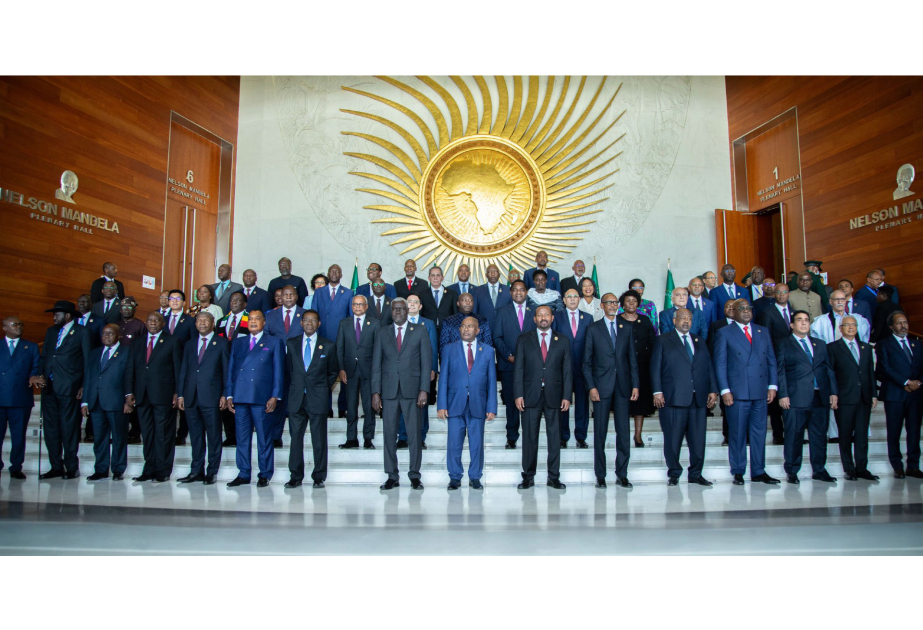
African Heads of States at the AU Summit 2026 (Courtesy)
Addis Ababa, February 15, 2026
Savanna News
African Union leaders meeting in Addis Ababa at the 39th Ordinary Summit have adopted a robust resolution on South Sudan, urging Juba’s leaders to recommit to the 2018 peace deal and deliver credible elections by December 2026. President Salva Kiir used his address to the Summit to defend his government’s readiness for polls while appealing for greater African support to safeguard peace and stability in the young nation.
AU resolution on South Sudan
The resolution, building on recent deliberations of the AU Peace and Security Council (PSC), reaffirms that the Revitalized Agreement on the Resolution of the Conflict in South Sudan (R‑ARCSS) remains the only viable framework for sustainable peace in the country. It underscores that there is no military solution to South Sudan’s crisis and “strongly urges” all political actors to recommit to dialogue, consensus‑building, and the permanent ceasefire. The Summit calls for priority to be given to organizing national elections by December 2026, in line with the transitional roadmap and the aspiration to end the transition by February 2027. It further emphasizes the need to support key national institutions involved in constitution‑making, census, and electoral preparations, including the National Elections Commission, to ensure that polls are peaceful, inclusive, and credible.
The decision reflects mounting concern within the AU over reports of continued ceasefire violations, political tensions, and the risk of a relapse into large‑scale conflict. The AU Commission Chairperson has recently warned that stakeholders must put the interests of civilians first, exercise maximum restraint, and resolve disputes through peaceful means.
President Kiir’s speech at the Summit
Addressing the Assembly of Heads of State and Government, President Salva Kiir welcomed the AU’s renewed engagement and described South Sudan’s peace process as “fragile but progressing.” He reiterated his government’s commitment to holding elections in December 2026 and to convening a national dialogue to tackle unresolved political and security questions ahead of the polls.
Kiir stressed the importance of African unity and regional coordination, praising the work of the AU Ad‑Hoc High‑Level Committee on South Sudan (C5), IGAD, and the East African Community in supporting the country’s transition. He thanked regional leaders for their continued mediation efforts and endorsed proposals for a strengthened oversight and follow‑up mechanism involving the C5 and IGAD to monitor implementation of the peace agreement and electoral benchmarks.
The South Sudanese leader also called for increased technical and financial assistance to election and security institutions, arguing that timely support is essential to prevent spoilers from exploiting gaps in the transition. He appealed to partners to channel such support through AU‑ and region‑led frameworks, aligning with broader calls at the Summit for predictable funding of AU peace operations and political missions.
Regional and international reactions
Regional leaders, including members of the C5, welcomed Kiir’s presence and his public recommitment to peace as “a demonstration of his dedication to stability in his country.” However, they also underlined that rhetoric must be matched by concrete steps such as ending unilateral actions that undermine the R‑ARCSS, ensuring an inclusive political process, and protecting civilians from continued violence. The United Nations leadership, addressing the same summit, highlighted South Sudan as a key test for AU‑UN cooperation on peace and security and urged all parties to seize the “important chance to revive political dialogue and prevent renewed conflict.” Diplomats and civil society observers note that the AU’s new resolution, combined with President Kiir’s pledges in Addis Ababa, sets a clearer political timetable but warn that implementation in the coming months will determine whether South Sudan moves toward durable peace or back into instability.
The African Union (AU) Assembly at its 39th Ordinary Session (February 14-15, 2026, Addis Ababa) did not adopt a standalone formal resolution document on South Sudan, unlike prior PSC meetings. Instead, it endorsed and built on the key directives from the AU Peace and Security Council’s (PSC) 1326th meeting Communiqué (January 23, 2026), reaffirming the R-ARCSS as the sole framework for peace and urging accelerated implementation of the transitional roadmap toward December 2026 elections.
Key Specific Directives from PSC 1326th Communiqué (Endorsed at Summit)
-
Immediate ceasefire enforcement: Demands immediate, unconditional cessation of all hostilities, including aerial bombardments and clashes; strongly warns perpetrators of human rights violations (e.g., sexual violence, arbitrary detentions, extra-judicial killings) of accountability.
-
Political recommitment: Strongly urges South Sudan’s leaders to prioritize dialogue, consensus-building, political inclusion, and cessation of unilateral actions to avert peace process collapse.
-
Election and institutional priorities: Underscores urgent need to expedite unification of forces, permanent constitution-making, census, and election preparations for December 2026 polls; calls for resource mobilization and logistical support via AU Commission.
-
Accountability mechanisms: Emphasizes establishment of the Hybrid Court for South Sudan to prosecute crimes during the transitional period
-
Humanitarian access: Demands belligerents guarantee unfettered humanitarian access amid deteriorating situation from insecurity, Sudanese refugee influx, and climate impacts; appeals to agencies to sustain efforts.
-
Regional coordination: Underlines sustained IGAD-AU-UN engagements with RTGoNU, including release of political detainees (e.g., First Vice President) to enable dialogue and R-ARCSS implementation.
Summit Context and Outcomes
The Assembly highlighted the AU High-Level Ad Hoc Committee (C5) as pivotal for reviving dialogue and preventing conflict relapse, with leaders like President Kiir pledging adherence during speeches. No new numbered resolutions were issued post-1326th, but the Summit decision reinforces PSC calls for people-centered approaches, permanent ceasefire adherence, and inclusive transitional security arrangements. This framework aims to keep the fragile process on track amid ongoing violations and tensions.














Post comments (0)